
Research
Research
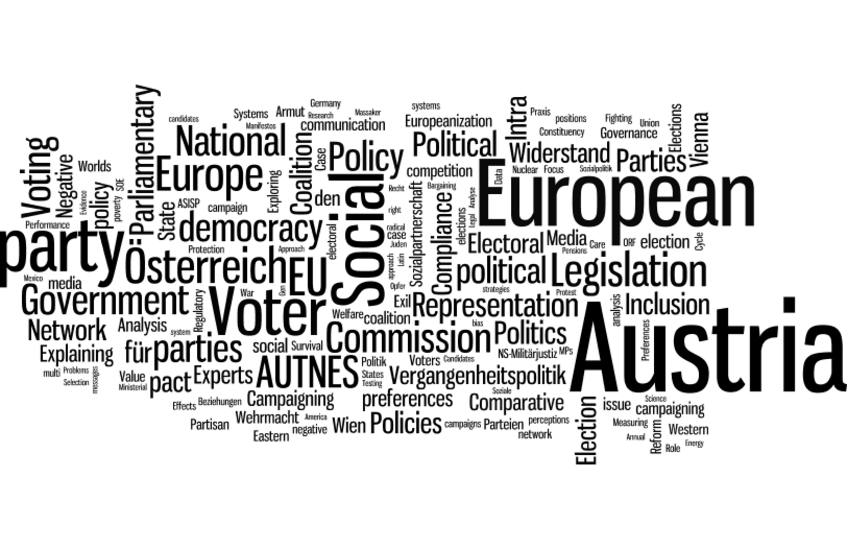
In its research and teaching, the Department of Government primarily focuses on comparative and Austrian politics. Its research is concerned with political behaviour, political actors, such as political parties and politicians, political institutions, the processes governed by these institutions, as well as their outcomes. It includes work on political participation, voting behaviour, parties and party competition, coalition politics and Austrian politics in general and is mostly based on rationalist and behavioural approaches.
Our goal is to conduct high-level, internationally competitive research in the area of Comparative Politics with the collaboration of international project partners and research networks. At the Faculty of Social Sciences the department is mainly engaged in the key research area ''Political Competition and Communication: Democratic Representation in Changing Societies'.
The department’s approach places it in the discipline’s empirical-analytical core and is mostly based on quantitative social science methods. To map empirical phenomena accurately, researcher in the department focus on the continuous development of survey design, as well as on the analysis of empirical data by applying the best suited statistical model. The department aims to achieve the best work on Austrian politics and to make important contributions to the international academic literature on Comparative Government and Politics.
An overview of current publications and activities at the department can be found below and on the personal websites of our team.
Political Institutions
Institutions play a key role in political systems, as they define the framework conditions for political decisions...
Political Representation
Political representation describes the institutional and social processes and practices that connect citizens and voters to...
Party Competition
Party competition is an essential component of democratic systems and describes the competition between political parties for votes...
Infrastructural Projects
Infrastructural projects are an essential component of scientific research, as they create the basis for long-term data collection...
Political Behaviour
Political behaviour deals with the individual and collective attitudes and actions of citizens in a political context...
Cooperations
Cooperations are a central component of scientific research, as they promote the exchange of knowledge, resources and...
Publications
How do voters form perceptions of party positions?
- Author(s)
- Thomas Meyer, Markus Wagner
- Abstract
Political debates are structured by underlying conflict dimensions, such as left-right and economic and cultural ideology, which form the basis for voter choice and party competition. However, we know little about how voters arrive at perceptions of parties' positions on these dimensions. We examine how the emphasis parties place on the different issues that make up a higher-level ideological dimension affects perceptions of their position on that dimension. Using two population-based survey experiments, we present respondents with either short or long statements that communicate the same issue stances. We then test whether the length of statements affects positional perceptions on the higher-level dimension. The empirical results show support for our hypotheses and imply that political parties - and the context in which they compete - can affect their perceived position even if underlying issue stances remain stable.
- Organisation(s)
- Department of Government
- Journal
- British Journal of Political Science
- Volume
- 53
- Pages
- 1351-1362
- No. of pages
- 12
- ISSN
- 0007-1234
- DOI
- https://doi.org/10.1017/S0007123422000746
- Publication date
- 2022
- Peer reviewed
- Yes
- Austrian Fields of Science 2012
- 506014 Comparative politics
- Keywords
- ASJC Scopus subject areas
- Political Science and International Relations
- Portal url
- https://ucrisportal.univie.ac.at/en/publications/12674c5b-0ce5-4bad-a80e-c951f35aae6f