
Research
Research
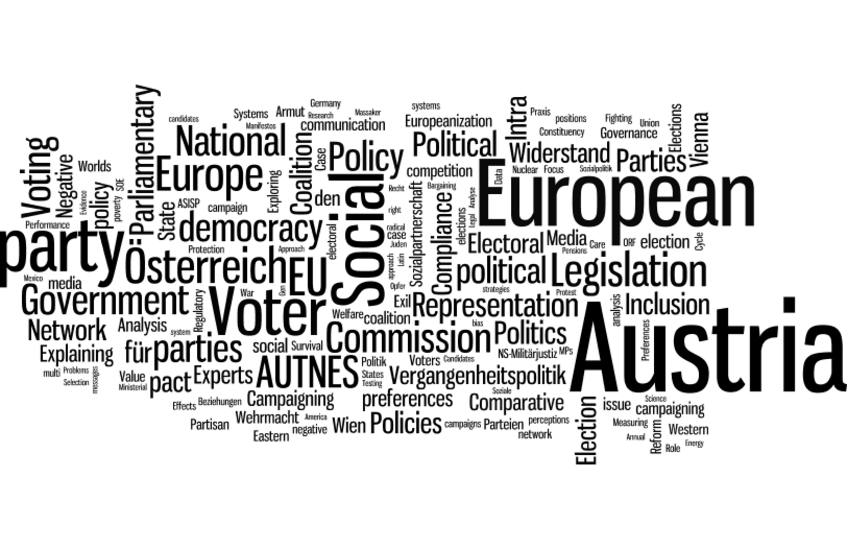
In its research and teaching, the Department of Government primarily focuses on comparative and Austrian politics. Its research is concerned with political behaviour, political actors, such as political parties and politicians, political institutions, the processes governed by these institutions, as well as their outcomes. It includes work on political participation, voting behaviour, parties and party competition, coalition politics and Austrian politics in general and is mostly based on rationalist and behavioural approaches.
Our goal is to conduct high-level, internationally competitive research in the area of Comparative Politics with the collaboration of international project partners and research networks. At the Faculty of Social Sciences the department is mainly engaged in the key research area ''Political Competition and Communication: Democratic Representation in Changing Societies'.
The department’s approach places it in the discipline’s empirical-analytical core and is mostly based on quantitative social science methods. To map empirical phenomena accurately, researcher in the department focus on the continuous development of survey design, as well as on the analysis of empirical data by applying the best suited statistical model. The department aims to achieve the best work on Austrian politics and to make important contributions to the international academic literature on Comparative Government and Politics.
An overview of current publications and activities at the department can be found below and on the personal websites of our team.
Political Institutions
Institutions play a key role in political systems, as they define the framework conditions for political decisions...
Political Representation
Political representation describes the institutional and social processes and practices that connect citizens and voters to...
Party Competition
Party competition is an essential component of democratic systems and describes the competition between political parties for votes...
Infrastructural Projects
Infrastructural projects are an essential component of scientific research, as they create the basis for long-term data collection...
Political Behaviour
Political behaviour deals with the individual and collective attitudes and actions of citizens in a political context...
Cooperations
Cooperations are a central component of scientific research, as they promote the exchange of knowledge, resources and...
Publications
Wie lässt sich konstruktiv mit verhärteten Wissenskonflikten umgehen?
- Author(s)
- Alexander Bogner, Agnes Kirchner, Katharina Miko-Schefzig, Julia Partheymüller, Michaela Pfadenhauer, Markus Trimmel
- Abstract
Die Pandemie hat gezeigt, wie schnell die Wissenschaft zum Gegenstand öffentlicher Konflikte und Attacken werden kann, wenn Expertise zur zentralen politischen Ressource wird. Daraus ergeben sich zwei grundsätzliche Fragen: (1) Warum trägt eine Verwissenschaftlichung von Konflikten nicht zu deren Lösung bei? (2) Und wie lässt sich ein konstruktiver politischer Dialog über wissenschaftsbasierte Themen dennoch stärken? Die erste Frage wird im qualitativen Teil der Studie behandelt: Es wird gezeigt, dass in hochgradig verwissenschaftlichten Krisen alle Konfliktparteien sich auf Expert:innen (oder Pseudoexpert:innen) berufen. Der Konflikt wird selbst zum Mittel, um epistemische Autorität dort, wo eine institutionelle Basis fehlt, situativ zu behaupten. Dies erklärt das Desinteresse der Maßnahmengegner:innen an einer Konfliktlösung. Im quantitativen Teil der Studie wird die zweite Frage diskutiert: Anhand von Survey-Experimenten wird gezeigt, dass sich das Vertrauen in die Wissenschaft steigert, wenn die politikberatenden Expert:innen nicht von der Regierung, sondern von der Wissenschaft selbst ausgewählt werden. Außerdem spielt der Kommunikationsstil der Expert:innen eine wichtige Rolle: Vertrauen entsteht dort, wo sie nicht als missionsgetriebene Aktivist:innen auftreten, sondern als bescheidene Berater:innen, die der Politik verschiedene, gut begründete Handlungsoptionen eröffnen. Allerdings haben Expert:innen im Fall stark politisierter Themen sowieso einen schweren Stand, wie der Vergleich mit politisch unbelasteten Themen zeigt.
- Organisation(s)
- Department of Government, Department of Sociology
- External organisation(s)
- Wirtschaftsuniversität Wien (WU)
- No. of pages
- 48
- Publication date
- 2025
- Austrian Fields of Science 2012
- 509017 Social studies of science, 504007 Empirical social research, 211917 Technology assessment, 508016 Science communication
- ASJC Scopus subject areas
- Sociology and Political Science
- Sustainable Development Goals
- SDG 16 - Peace, Justice and Strong Institutions, SDG 3 - Good Health and Well-being, SDG 9 - Industry, Innovation, and Infrastructure
- Portal url
- https://ucrisportal.univie.ac.at/en/publications/43887eee-4acd-40d7-adfe-db2c62e2f6ca